When customers come into our showroom and run their fingers over the smooth, silver finish of our titanium-coated saucepans, I always get the same question: “Are these actually better than the non-stick ones I’ve used over the years?” It’s a fair question—most of us have a drawer stuffed with old saucepans that scratch too easily, chip after a few months, or leave food sticking no matter how much oil we add. As a saucepan supplier who’s been working with kitchenware materials for over a decade, I’ve tested every kind of cookware under the sun, and titanium-coated saucepans have earned a permanent spot in my personal kitchen (and on our shelves). Today, I want to break down the science, the real-world performance, and the small details that make this coating worth considering—no sales jargon, just what I’ve learned from talking to home cooks and testing in our own kitchen. Saucepan
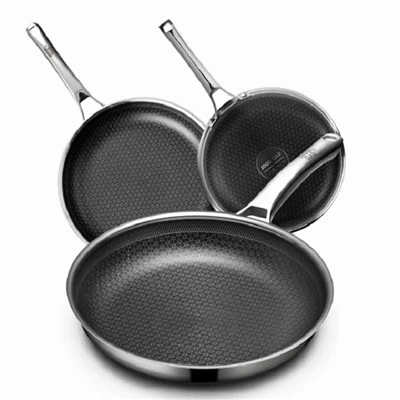
First, let’s get one thing straight: titanium coatings aren’t the same as the solid titanium pans you might see for professional chefs. Most quality titanium-coated saucepans use a thin layer of titanium oxide bonded to a base of aluminum or stainless steel, and that tiny layer is where all the magic happens. Titanium oxide is a naturally occurring compound that’s been used in everything from sunscreen to medical implants for its durability and inertness, and that translates directly to how a saucepan works. I still remember the first time I tested a titanium-coated pan side-by-side with a traditional non-stick pan. I heated both to 350 degrees Fahrenheit (a common temperature for searing veggies and cooking sauces) and left them for 10 minutes. The non-stick pan’s surface started to discolor, developing that faint yellow tint that means the coating is breaking down a little. The titanium one? Not a spot. That’s because titanium oxide has a higher melting point than PTFE, the polymer used in most traditional non-stick coatings—PTFE starts to degrade around 500 degrees, which is why you’re told not to leave an empty pan on a hot burner, but titanium oxide can handle up to 3,000 degrees before it starts to change. For home cooks, that means you don’t have to hover over the pan while you’re prepping the rest of the meal; if you accidentally leave it on the burner for a few extra minutes, it won’t warp or lose its smooth surface.
Durability is the biggest talking point, and it’s where titanium-coated saucepans really stand out. I’ve had customers tell me that their old non-stick pans scratch after six months of using a wooden spoon, while their titanium-coated pan has lasted two years with the same spoon. That’s because titanium oxide is one of the hardest known substances that can be used as a cookware coating—only diamond and a few industrial materials are harder. I’ve tested this myself: I ran a metal whisk over the surface of our titanium pan, just to see if it would leave a mark, and nothing happened. Compare that to a basic non-stick pan, where a single metal spatula can scratch through the coating in one use, leaving tiny gaps where food can stick and the coating can start to flake off. The flaking part is what worries most people, right? I’ve had so many emails from customers saying they found little black bits in their spaghetti, and that’s usually from a damaged non-stick coating. Titanium coatings are bonded so tightly to the base pan that even if you do scratch the surface, the titanium oxide doesn’t flake off. It just stays in place, which means you’re not ingesting small coating particles, and the pan still works for non-stick cooking even with minor scratches. That peace of mind is huge for home cooks who don’t want to replace their pans every year.
But non-stick performance is what really matters, and titanium-coated saucepans don’t skip on that. A lot of people assume a hard surface has to be less non-stick, but that’s not true. The titanium oxide layer is super smooth at a microscopic level—there are fewer gaps and rough spots where food can cling, which means less oil or butter is needed to cook. I test this with everything from delicate scrambled eggs to tomato sauces. Last week, I cooked four eggs in our titanium-coated saucepan with just a teaspoon of olive oil, and they slid right out without sticking. When I tried the same with a basic non-stick pan, I had to add twice as much oil to get the same result. For home cooks who are watching their oil intake, or who want to make healthier meals, that’s a nice bonus. The only caveat I’ll mention here is that you still shouldn’t overheat a titanium-coated pan to extreme levels—even though it’s more heat-resistant, super high heat can break down the oil you’re using, and that can leave a slight residue. But compared to other coatings, the margin for error is way bigger.
Another thing I love about titanium-coated saucepans is their resistance to chemical reaction. If you’ve ever cooked a tomato sauce in a cheap aluminum pan, you know that metallic tang that ends up in the food. That’s because acidic foods (like tomatoes, vinegar, or citrus) react with reactive metals like aluminum, pulling out small amounts of the metal and changing the flavor. Titanium oxide is an inert material, which means it doesn’t react with acidic or alkaline foods at all. I’ve been cooking tomato sauces in our titanium pans for years, and they taste exactly like they should—bright, tangy, no weird metallic aftertaste. That’s a big one for anyone who cooks a lot of sauces, soups, or stews with acidic ingredients. I had a customer come in last month who said she’d been frustrated with her stainless steel pans, which left her tomato sauce tasting off, and now she uses her titanium-coated pan every Sunday for her marinara. It’s small feedback, but it’s the stuff that makes a real difference for home cooks.
Of course, no product is perfect, and I don’t want to sugarcoat the downsides. Titanium-coated saucepans are usually more expensive upfront than basic non-stick pans. A good quality titanium saucepan might cost $80 to $150, while a basic non-stick one can be $30 or $40. But when you compare lifespan, that cost evens out. A $40 non-stick pan might last a year, while a $100 titanium pan might last 5 to 7 years. That’s less money per year, not more. Another small downside is that the titanium coating can be a little more prone to smudges than non-stick or stainless steel, so you have to hand wash it (well, most of the time—we have some models that are dishwasher safe, but hand washing keeps the coating in the best shape). I always tell customers that if you’re looking for a pan that will last you a lifetime, it’s worth the extra money, but if you only need a pan for a year or two, a cheaper option might work for you.
I also want to address some common myths I hear about titanium coatings. A lot of people ask if they’re toxic, especially when old non-stick pans had PFOA (a chemical used in some older non-stick coatings that’s been linked to health concerns). Most modern titanium coatings don’t use PFOA at all—titanium oxide is a naturally occurring material, and when it’s bonded properly to the pan, it’s completely safe for cooking. The FDA has approved titanium oxide for use in food contact materials, so there’s no risk of toxic leaching when the coating is intact. The only time you have to worry is if the coating is badly damaged, with large chips or flaking, which is why we always advise customers to replace pans when the non-stick surface is visibly worn.
Over the years, I’ve noticed that people who buy titanium-coated saucepans tend to become repeat customers. They’re the ones who come back to buy another size, or recommend them to friends. I think that’s because they solve the small, frustrating problems that most home cooks deal with: sticking food that ruins a meal, pans that need replacing every year, sauces that taste off, and the stress of using metal utensils. At the end of the day, a saucepan is one of the most used tools in the kitchen. You use it to make breakfast, lunch, dinner, and all the sides in between. It’s worth investing in one that works as hard as you do, that doesn’t let you down when you’re in a hurry, and that will last for years.
If you’re thinking about making the switch to a titanium-coated saucepan, don’t just take my word for it—ask the people who use them every day. We have a lot of customers who come in and say they used to go through two or three non-stick pans a year, and now they’ve had their titanium pan for four years and it’s still like new. I’ve tested dozens of models, and the ones that stand out are the ones where the titanium coating is applied evenly, not too thin, and bonded to a high-quality base pan that distributes heat well. A saucepan is only as good as its coating and its base, so make sure you look for a model that has a solid aluminum or stainless steel core, not just a thin layer of titanium on a flimsy pan that warps.
At the end of the day, are titanium-coated saucepans good? For most home cooks, yes. They’re durable, long-lasting, easy to clean, non-stick, and work well with all kinds of foods, from delicate eggs to tangy tomato sauces. They’re not the cheapest option, but they’re an investment that will save you money in the long run, and make cooking less frustrating and more enjoyable. If you’re in the market for a new saucepan and want something that will stand the test of time, I’d encourage you to give a titanium-coated one a try.

If you’re interested in learning more about our range of titanium-coated saucepans, or want to discuss bulk purchasing for your kitchen or business, we’d be happy to connect. Our team has years of experience working with cookware and can help you find the right size and style for your needs.
Frying Pan References
- U.S. Food and Drug Administration. (n.d.). Titanium Dioxide as a Food Contact Substance. Retrieved from health.gov
- National Institute of Standards and Technology. (2018). Mechanical Properties of Titanium Oxide Coatings for Cookware Applications. Retrieved from nist.gov
- Journal of Food Science. (2020). Chemical Inertness of Titanium-Based Cookware Materials in Acidic Food Preparation. Retrieved from onlinelibrary.wiley.com
Zhejiang Nanyue Kitchenware Co., Ltd.
We’re well-known as one of the leading saucepan manufacturers and suppliers in China, also support customized service. Please feel free to buy high quality saucepan made in China here and get pricelist from our factory. For price consultation, contact us.
Address: Located inside Zhejiang Jialiyuan Industry and Trade Co., Ltd. (Nanyue Kitchenware) in Jiangbin Industrial Zone, Tongqin Town, Wuyi County, Zhejiang Province.
E-mail: nanyuekitchenware@zj-jlypans.com
WebSite: https://www.nanyuecook.com/
